
Commons Failure
A field guide to the people exploiting and exploited by shared systems

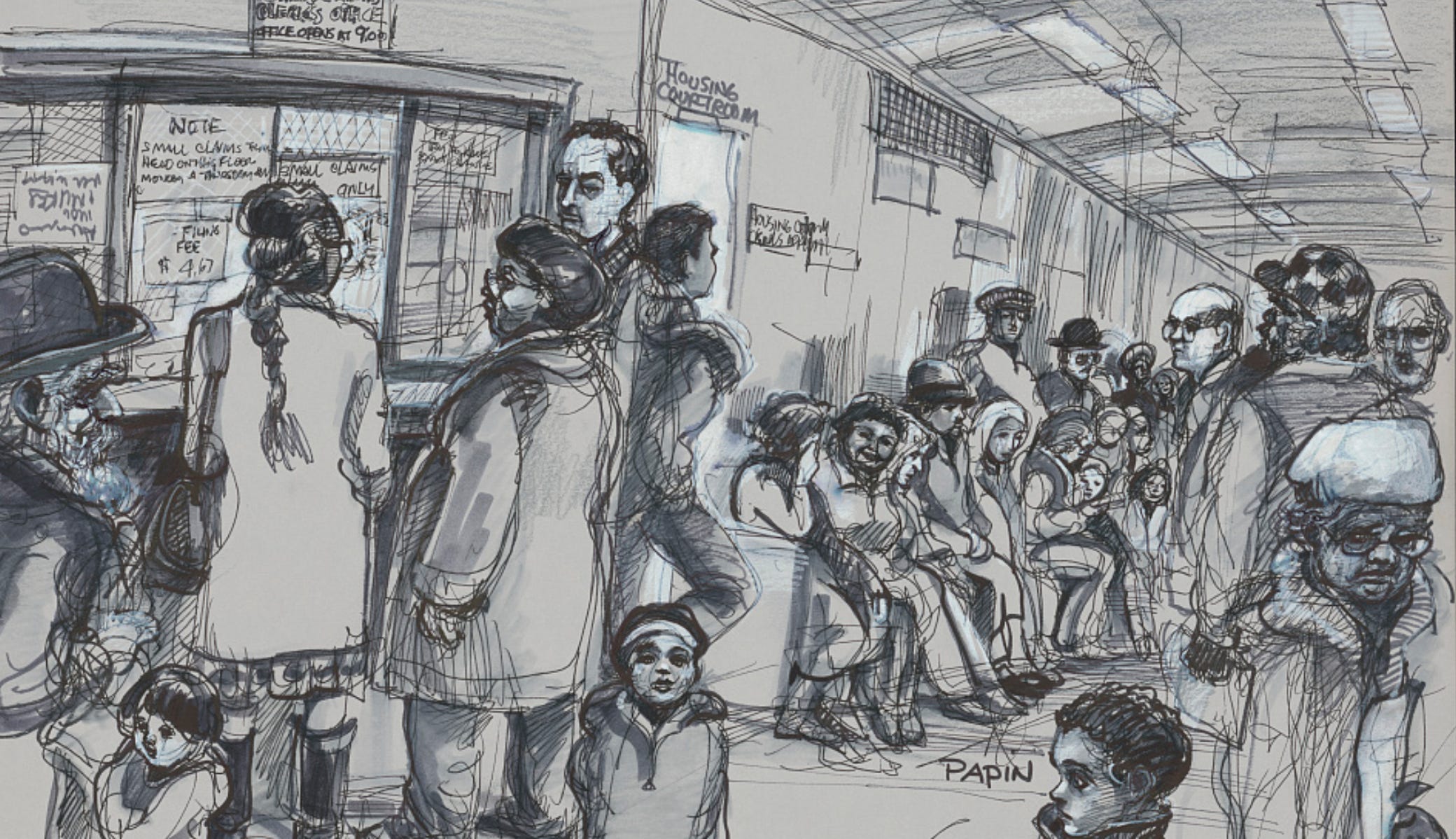
Most user research runs on self-report. This runs on the record.
What people say they’d do under stress, obligation, or temptation is not reliably what they do. Court filings, inspection reports, and lease documents capture the second thing — after the fact, under oath or under signature, with a paper trail that doesn’t move once it’s filed.
Catcher in the Commons treats the record as primary research. It’s the standard persona-building exercise, refined with the rigor of investigative journalism and academic research — applied to product work instead of a courtroom or a dissertation. Every specimen is sourced. Every claim is traceable. And every issue ends with the same question a product team actually has to answer: what would have stopped this, and whose job is it to build that?
Why we’re mapping this
A commons is any shared system built on the assumption of good faith: a small claims court that doesn’t require a lawyer, a tenant screening tool that approximates judgment at scale, an insurance claims process that takes a homeowner’s account seriously without demanding a forensic audit, a civil rights statute that lets an individual enforce a law the government doesn’t have the staff to enforce alone. Each of these was designed by someone who pictured a specific person using it — and pictured them honestly.
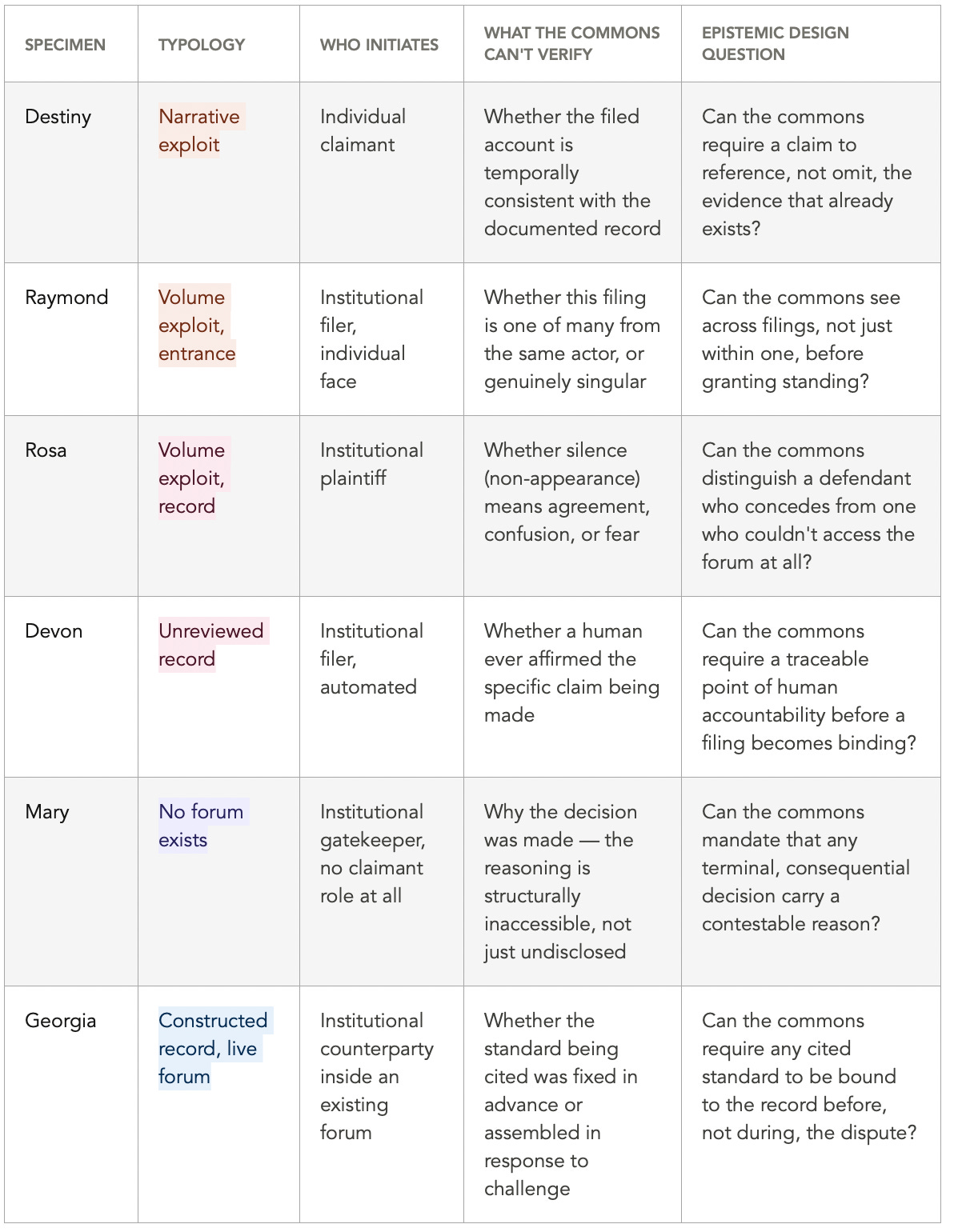
What the six specimens in this collection show, over and over, is that the picture was always partial. Not wrong, exactly. Incomplete in a specific, recoverable way. Every commons in this collection was designed around an idealized user — and every one of them is now also being used by someone the design never accounted for: a tenant who paints first and litigates second, a law firm that treats a civil rights statute as a billing engine, a lender that treats a courtroom as a collections department, a screening algorithm with no one behind it accountable for an answer.
This isn’t a story about bad actors slipping past good design. It’s a story about good design that stopped at the first user it could picture, and never returned to ask who else would eventually show up. Destiny isn’t a hack in the small claims system; she’s a predictable consequence of a system that assumes a claimant’s account is offered in good faith, because building a system that assumes otherwise is expensive, adversarial, and corrosive to the cases where good faith is exactly what’s present. Raymond’s firm isn’t a bug in the ADA; it’s what happens when a private right of action — created because the government alone could never police every doorway and parking space in the country — meets a venue with no mechanism for noticing that the same plaintiff has now appeared three hundred times. Mary isn’t an edge case in tenant screening; she’s the first visible casualty of a design decision nobody made on purpose: the decision that a score doesn’t need an explanation attached to it.
Why this falls to designers, specifically
Legislators write the statute. Regulators write the rule. But the actual shape of who can use a system, and how, and what happens when they’re lying or being lied to, gets decided by the people who build the interface, the workflow, the default settings, and the data schema that sits underneath all of it. The ADA didn’t create Raymond’s firm. A docket system with no cross-filing visibility did. The Fair Housing Act didn’t deny Mary an appeal. A product decision to ship a terminal score without an override path did. The law set the floor. The product set the actual experience of standing on it.
That means the people best positioned to repair a commons are rarely the people who wrote the law that commons sits on top of. They’re the people who will build the next version of the screening tool, the next claims-intake system, the next court-filing software, the next small claims interface. Those decisions are made by designers and product teams far more often than they’re made by legislatures, and they’re made faster, with less oversight, and with much less public scrutiny than a statute ever gets.
This is also, increasingly, an AI design problem and not just a workflow design problem. The next generation of these systems will not be a form with fields and a submit button — it will be an agent that drafts the complaint, an algorithm that sets the score, a model that decides whether an appeal gets a second look. Software that used to require a person to deliberately decide to file 36,500 lawsuits will soon make that decision look like a default setting nobody actively chose. The asymmetries this collection documents — volume against an individual, opacity against an applicant, narrative against a record — get cheaper to produce and harder to see with every layer of automation between the decision and the person who has to live inside it. A designer who doesn’t understand who already exploits a commons will build the next version of it faster, at greater scale, with less friction for exactly the wrong kind of user.
What “restoring” actually means here
Restoration isn’t nostalgia for some earlier, purer version of these systems. None of them was ever pure. Small claims court was never free of bad-faith filers; ADA enforcement was never free of opportunists; tenant screening was never free of bias, just less efficient at scaling it. What’s available now that wasn’t available before is the capacity to see the pattern while it’s still small. Raymond’s firm’s migration from LA to the Bay Area was visible in public court data years before two district attorneys’ offices acted on it. Rosa’s lender’s filing volume was documented by a nonprofit research group using nothing but public county records. The patterns are not secret. They are simply not designed for — which is a different problem, and a more solvable one.
A designer who studies these specimens before building the seventh version of a screening tool, a claims platform, or a filing system isn’t trying to make the system cynical or distrustful by default. The goal isn’t to design for the worst-case user at the expense of everyone else — that produces its own failure mode, the system so locked down that Mary’s sixteen years of on-time rent can’t override a credit score, or so suspicious of every claimant that the genuine small claims plaintiff with a real grievance gets buried under the same friction built to stop Destiny. The actual design discipline here is narrower and harder: build systems that can tell the difference. A commons doesn’t need to assume the worst about everyone. It needs the capacity to notice — early, cheaply, and without punishing the honest majority — when one of its users is not who the original design assumed.
That capacity has to be designed in on purpose. It doesn’t show up by default, and right now, in most of these systems, it hasn’t shown up at all.
The seventh typology, arriving now
Every specimen documented so far depends on a gap in literacy that already existed before any of this software showed up: Mary couldn’t decode a scoring algorithm because no one could, regardless of how educated she was. Rosa couldn’t parse “default judgment” because the term itself is opaque, not because she lacked capacity. These are commons that failed people through opacity built into the system — a problem you can point to, name, and eventually regulate, because the opaque thing is a fixed artifact. The score exists. The form complaint exists. You can subpoena it.
What’s arriving now is a different shape of the same problem, and it doesn’t sit still long enough to subpoena. As more of these interactions become AI-mediated — a chatbot drafting your dispute response, an agent filling out your claim, a model deciding which evidence to surface to an adjuster — the outcome a person gets increasingly depends on how well they can prompt the system standing between them and the commons. That’s a literacy nobody has named yet, let alone taught, and it’s not evenly distributed for reasons that have nothing to do with the merits of anyone’s case.
The person who knows to ask an AI tool to “draft this as a formal dispute citing the specific lease clause and statutory deadline” gets a materially different output than the person who types “they’re trying to keep my deposit, help.” Both have identical facts. Both may have identical legal standing. The gap between them is now a gap in prompting fluency — which correlates, predictably and unfairly, with exactly the same lines that already predict disadvantage: English fluency, formal education, prior exposure to bureaucratic systems, simple familiarity with how these tools expect to be talked to. Destiny, fluent in performance and narrative construction, would prompt circles around Rosa. That asymmetry doesn’t require either of them to be acting in bad faith — it just requires one of them to know the register the system rewards.
This is a harder typology to document than the first six, for a specific reason: there’s no filed record of a prompt that wasn’t written. Rosa’s case file shows what happened in court. It will never show the version of her dispute that got drafted in someone’s head and never typed, because she didn’t know that typing it a certain way mattered. The harm is a counterfactual — the absence of an interaction that should have happened — and absence is exactly the thing this collection has already flagged as the hardest evidence to make legible.
What a protocol for this would need to do
If forum design was the right intervention for specimens one through five, and decision design was the right intervention for Mary, this one calls for something earlier and more basic: interface design that doesn’t outsource literacy to the user at all. A commons that requires a well-crafted prompt to produce a fair outcome has just relocated the old paperwork barrier into a new vocabulary, dressed as a convenience. The actual fix isn’t a better prompt guide handed to the public, though that’s the version every vendor will ship first because it’s cheap and shifts the responsibility back onto the person already being failed. The fix is systems that ask the clarifying questions a skilled prompter would have known to ask up front — systems where the burden of translating a real grievance into the system’s preferred register sits with the tool, not the tenant, the patient, or the small business owner.
That’s the specimen this collection doesn’t have yet, because it’s still being built in real time, in products being shipped this year. Worth watching for: the first documented case of two people with identical underlying facts, identical access to the same AI tool, and meaningfully different outcomes — purely as a function of how each one phrased the request.
I'm remembering back to '93; my first 'office modernisation' for the city hall I was hired for, a pleasant ex-urban town of 6,400 in western Illinois. A phone voice-messaging system that'd eliminate the triplicate, hand-written messages the receptionist would take and distribute. "It's more efficient", I said.
In hindsight, I'm not sure it saved anything, but that's the descriptor the phone provider used; so did I.
I'm revisiting a lecture that historian Timothy Snyder gave eight years ago, in which he discussed the clash between the politics of inevitability vs the politics of eternity; and, BOTH of these 'philosophies' together provide a convenient binary 'excuse' for not taking responsibility, because BOTH allow the future, or the past to set the terms. Ie; "everything will be better in the future because, well, PROGRESS!"
Here, FYI, 45 minute lecture: https://youtu.be/6rRW7EvWqZk?si=-rDeTB7wYzYLu6YP
I think the 'proponents' of this new 'progress' are counting on all of us to self-justify thisnext big thing on both forms of this duality of 'politics', not to mention a Sorcerer's Apprentice dose of power. And it inconveniences us all in small and huge ways, at a lavish expenditure of resources. And then, besides, "what are people for?"
Thanks for this.
Tim Long, Just Up the Hill from Lock 15